> For the complete documentation index, see [llms.txt](https://ask.birdie.ai/llms.txt). Markdown versions of documentation pages are available by appending `.md` to page URLs; this page is available as [Markdown](https://ask.birdie.ai/frontline-intelligence/criteria.md).
# Criteria
## Overview
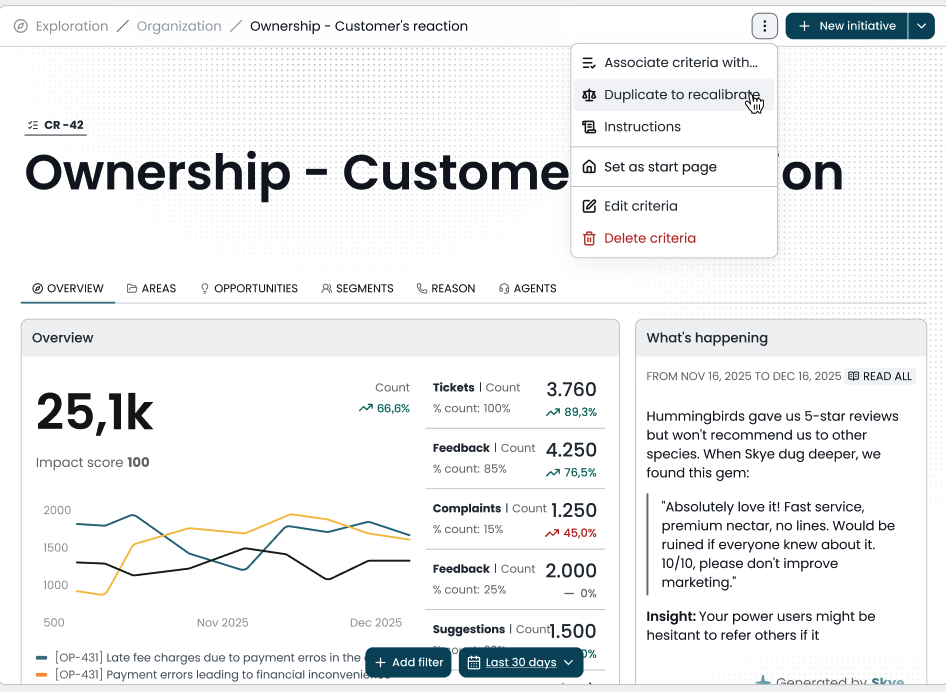
Criteria are the FI rules Birdie uses to evaluate observable agent behavior in customer interactions.
They turn service quality into something consistent, measurable, and scalable.
A strong criterion describes one observable behavior that can be verified from the interaction itself.\
## Why criteria matter
Criteria help teams:
* evaluate quality with the same standard across agents
* identify specific service failures
* understand which behaviors affect quality scores most
* guide coaching, calibration, and process improvement
## How criteria work in FI
Criteria can be:
* **General** — applied across interactions
* **Specific** — linked to a specific [Reason](/frontline-intelligence/reasons.md)
Criteria can also be evaluated in two ways:
* **AI** — Birdie evaluates the criterion automatically from the transcript
* **Manual** — a person evaluates the criterion in [Manual Evaluation](/frontline-intelligence/manual-evaluation.md)
## How criteria affect scoring
* **Weight** contributes to the Quality Score at Workspace, Area, Reason, and Agent levels
* **Critical** criteria do not use weight
* Failing one **Critical** criterion fails the interaction for that Reason
* **Manual** criteria still contribute to reporting once the evaluation is submitted
## What makes a good criterion
Good criteria are:
* objective
* specific
* tied to observable agent behavior
* independent from customer opinion or assumptions
{% hint style="info" %}
Manage the full criteria catalog in [Taxonomy → Criteria](/admin-and-settings/taxonomy/criteria.md).
{% endhint %}
## Criteria in analysis
In analysis, criteria help you understand which behaviors pass, fail, or require manual review across teams, reasons, and agents.
The **Criteria** analysis page follows the same layout described in [Analysis Page Structure](/getting-started/platform-overview.md).
## Best practices
* Write one observable rule per criterion
* Use manual criteria when transcript-only evaluation is not reliable
* Review critical and weighted criteria carefully, because they affect scoring
## Related articles
* [Taxonomy → Criteria](/admin-and-settings/taxonomy/criteria.md)
* [Manual Evaluation](/frontline-intelligence/manual-evaluation.md)
* [Reasons](/frontline-intelligence/reasons.md)
---
# Agent Instructions
This documentation is published with GitBook. GitBook is the documentation platform designed so that both humans and AI agents can read, navigate, and reason over technical content effectively. Learn more at gitbook.com.
## Querying This Documentation
If you need additional information that is not directly available in this page, you can query the documentation by asking a question.
Perform an HTTP GET request on the following URL with the `ask` and `goal` query parameters:
```
GET https://ask.birdie.ai/frontline-intelligence/criteria.md?ask=&goal=
```
`ask` is the immediate question: it should be specific, self-contained, and written in natural language.
`goal` is what the user is ultimately trying to achieve, the reason they need the answer. Sharing it helps GitBook give you a better, more relevant answer. A goal is most helpful when it describes the outcome the user wants rather than restating the question. For example, with `ask=how do I create an API token`, a goal like `automate deployments from our CI pipeline` lets GitBook tailor the answer to that use case.
The response will contain a direct answer to the question and relevant excerpts and sources from the documentation.
Use this mechanism when the answer is not explicitly present in the current page, you need clarification or additional context, or you want to retrieve related documentation sections.