> For the complete documentation index, see [llms.txt](https://ask.birdie.ai/llms.txt). Markdown versions of documentation pages are available by appending `.md` to page URLs; this page is available as [Markdown](https://ask.birdie.ai/~/revisions/82QMrzVaBqzhXDJPEWZO/agent-quality-assurance/criteria.md).
# Criteria
## What are Criteria and what are they used for?
**Description**\
Criteria in Birdie are evaluation rules used to identify **specific errors made by agents during a customer interaction**, based exclusively on what can be verified from the conversation (transcript). They act as objective **Quality Assurance (QA)** mechanisms, enabling consistent and scalable monitoring, classification, and measurement of agent performance.
A criterion always describes an **agent action (or lack of action)** that can be clearly identified in the dialogue, such as failing to inform a delivery deadline, not confirming mandatory data, or not following an expected procedure. To be considered viable, a criterion must be clear, objective, non-subjective, and verifiable solely through the interaction content. Filters or external information may be used only to **define the analysis scope**, never to directly identify the failure.
Criteria can be classified into two main types:
* **General criteria**: applied to all interactions, regardless of the contact reason. These typically cover mandatory best practices or standard procedures.
* **Specific criteria**: applied only to **particular processes or service flows**. These criteria must always be **linked to a Reason (contact reason)** to ensure the evaluation happens within the correct service context.
Specific criteria can be further categorized by how they are evaluated:
* **AI criteria**: automatically evaluated by Birdie’s models based on the transcript.
* **Manual criteria**: used when a process is **too specific, complex, or contextual** to be reliably evaluated by AI, requiring human review instead.
When a criterion does not meet minimum performance thresholds or when the customer requests support, Birdie’s internal team performs an **internal calibration**, reviewing and adjusting the criterion’s title, instructions, and logic until it is viable and effective.
Criteria are essential to:
* Evaluate service quality in a standardized way
* Identify concrete operational failures by agents
* Support performance analysis with reliable metrics
* Enable targeted improvements in processes and training
**Important:** Criteria are directly related to **service quality evaluation (QA)** and always focus on observable agent behavior, unlike VoC-oriented analyses, which capture customer perception and do not describe objectively verifiable actions.
## Creating New Data
{% stepper %}
{% step %}
### Click the "+ Add criterion" button
{% endstep %}
{% step %}
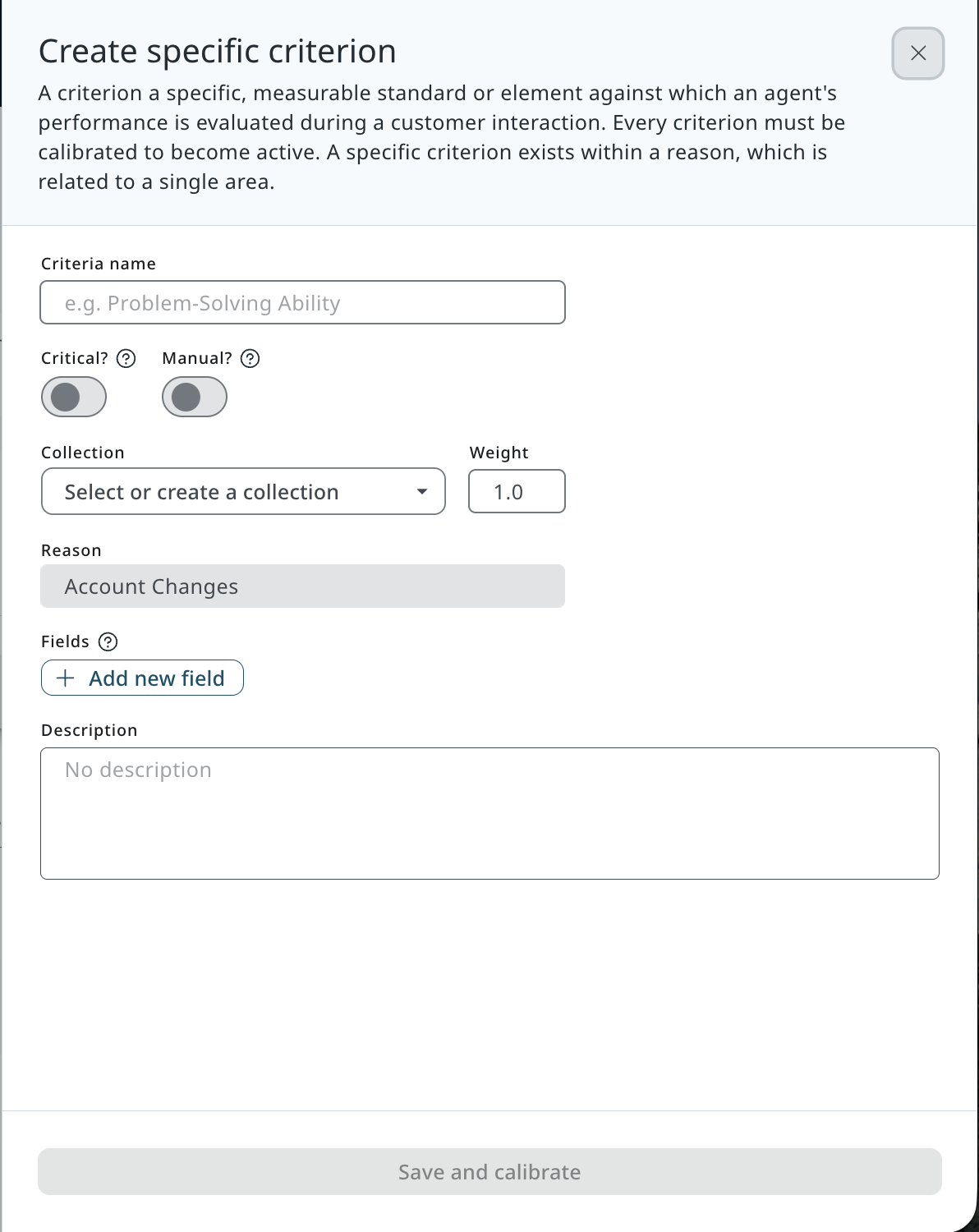
### Fill in the form
### Fields in the form
* **Name**, the primary label for the criteria, which can be changed anytime.
* **Critical?**, failing a critical criterion means the entire interaction is considered a failure, regardless of how well the agent performed on other, less critical criteria. Critical criterion don't have Weight\
**Manual?**, when a criterion can not be AI evaluated and need to be manually evaluated
* **Select or create a collection**, which collection this Criterion belongs to.
* **Fields,** select fields to give context when evaluating the criteria
* **Weight**, a numerical value used to calculate the Quality Score at various levels (Workspace, Area, Reason, and Agent).
* **Description**, a place to describe your Criteria.
{% endstep %}
{% step %}
### Save & Calibrate
Click Save and Calibrate to watch the setup guide. Ensure a 'Scope filter' is defined and follow the instructions. Items status as 'Pending calibration' or 'With specialists' are hidden from the main list but can be managed via the Pending Criteria banner.
{% endstep %}
{% endstepper %}
---
# Agent Instructions
This documentation is published with GitBook. GitBook is the documentation platform designed so that both humans and AI agents can read, navigate, and reason over technical content effectively. Learn more at gitbook.com.
## Querying This Documentation
If you need additional information that is not directly available in this page, you can query the documentation dynamically by asking a question.
Perform an HTTP GET request on the current page URL with the `ask` query parameter, and the optional `goal` query parameter:
```
GET https://ask.birdie.ai/~/revisions/82QMrzVaBqzhXDJPEWZO/agent-quality-assurance/criteria.md?ask=&goal=
```
`ask` is the immediate question: it should be specific, self-contained, and written in natural language.
`goal` is optional and describes the broader end goal you are ultimately trying to accomplish on behalf of the user. GitBook uses it to tailor the answer towards what is most useful for that goal.
The response will contain a direct answer to the question and relevant excerpts and sources from the documentation.
Use this mechanism when the answer is not explicitly present in the current page, you need clarification or additional context, or you want to retrieve related documentation sections.